
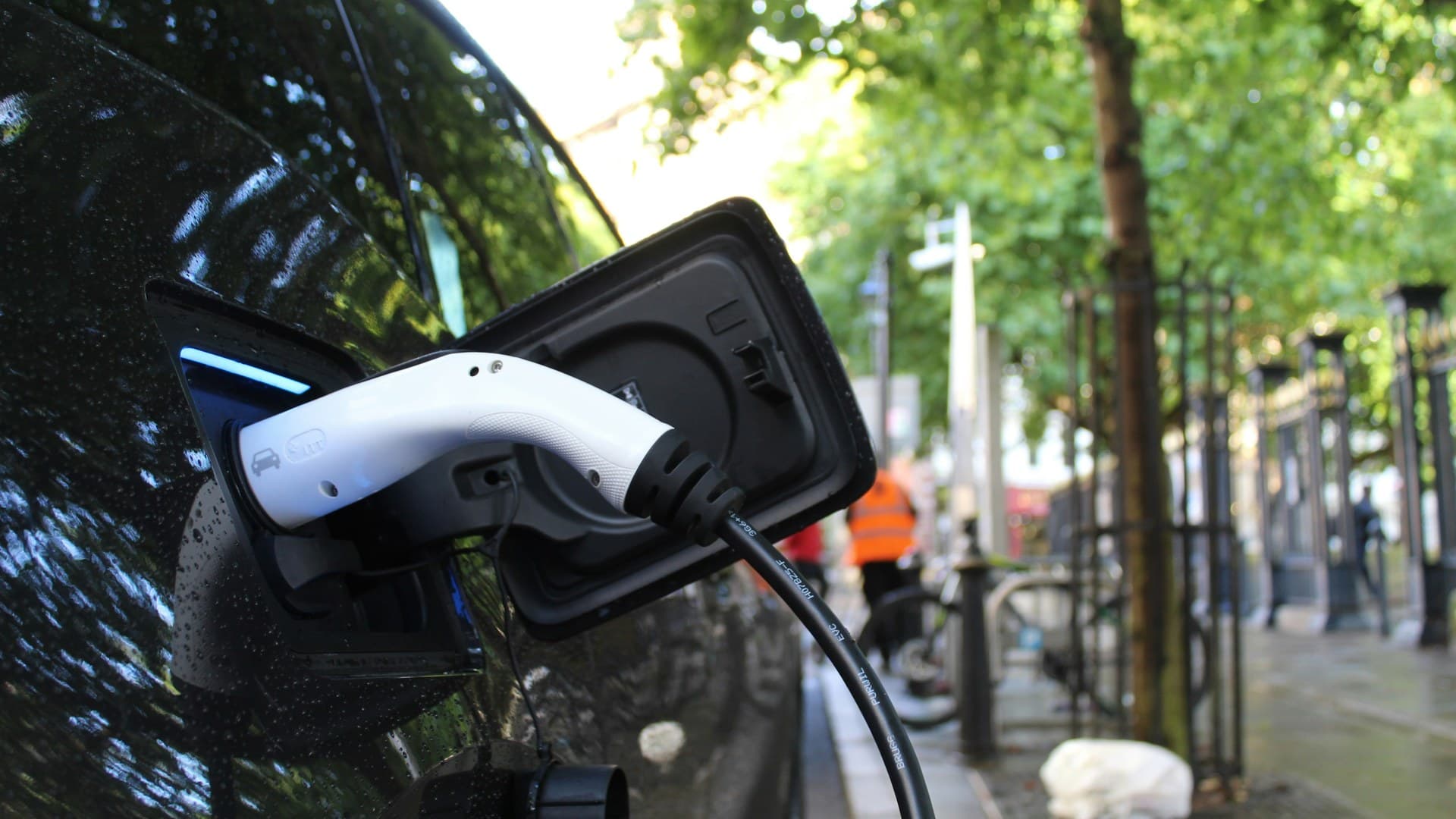
Every EV spec sheet gives you one number about charging: 10 to 80 per cent in twenty-two minutes, or twenty-eight, or thirty-five. It's a real number, measured under real conditions, and it is almost never the number that decides what time you arrive.
Here's the thing that took us a few long drives to notice. The charge is the only part of a charging stop that anybody publishes a figure for. Everything wrapped around it — leaving the road, finding the site, finding a working stall, waiting for the car ahead, the walk to the counter and back — has no spec sheet, no marketing claim, and no line in most people's plans. So it gets budgeted at zero.
It isn't zero. On a long drive it's often the bigger half.
How long does a charging stop actually take?
Start with the part we can pin down. On a DC fast charger, most batteries go from 10 to 80 per cent in twenty to forty-five minutes, depending on the car and the charger. At a 150 kW station, around thirty minutes is typical; on a 350 kW charger, a car that can actually take 350 kW can be done in under twenty.
The 10-to-80 framing isn't marketing convenience, either. Batteries charge fastest when they're nearly empty and slow down sharply past roughly 80 per cent — the last 20 per cent can take about as long as the first 70. Which is why the fastest way to cross a country is several short charges rather than one heroic session to 100 per cent.
So: twenty to forty-five minutes, plugged in. That's the honest range, and it's the number people plan with.
Why does the stop take longer than the charge?
Because the charge starts when you plug in, and the stop starts when you leave the road.
Between those two moments sits a list nobody writes down:
- Getting off and back on. A slip road, a roundabout or two, a set of lights, and the same again in reverse. Under a kilometre of driving can eat several minutes at 30 km/h that you'd have covered in seconds at 120.
- Finding the site. Chargers live behind supermarkets, at the far end of retail parks, in hotel car parks, in the corner of a services that signposts the fuel pumps and not the chargers.
- Finding a stall that works. Not every bay in a pool is live, and the one that's free is sometimes free for a reason.
- Waiting. If two cars are ahead of you at a two-stall site, your twenty-five-minute charge is an hour before you touch a cable.
- The human part. Nobody plugs in and stares at the car. You go for coffee, you queue for the toilet, you come back to find the session stopped at 78 per cent.
None of these is a scandal. They're all completely normal, and they're all invisible in the figure the car quotes you.
What that looks like in numbers
Below are three versions of the same 25-minute charge. The overheads are estimates, not measurements — they're the numbers we'd put in a plan, and the point is that you should replace them with your own once you know your own roads.
The good stop — charger on the motorway services
| Off the road and parked | 2 min |
| Plug in, authenticate | 2 min |
| Charging | 25 min |
| Unplug, back up to speed | 3 min |
| Total | 32 min |
Seven minutes of overhead on a 25-minute charge. This is the stop the spec sheet is describing, and it does exist.
The ordinary stop — 3 km off the exit, behind a retail park
| Exit, 3 km each way at town speeds | 12 min |
| Finding the chargers, parking | 4 min |
| Plug in, authenticate | 3 min |
| Charging (with a coffee walk) | 30 min |
| Back to the motorway | 8 min |
| Total | 57 min |
The charge grew by five minutes. The stop nearly doubled. This is the stop most long drives are actually made of.
The bad stop — one car ahead, two stalls, one working
Add twenty-five minutes of waiting to the ordinary stop and you're at 1 h 22 min. Do that twice on a 900 km day and you've lost an hour and a half against a plan that looked perfectly reasonable in the kitchen the night before.
Three stops on a long day, at 32 minutes each, is an hour and a half of stopping. The same three stops at 57 minutes is nearly three hours. Both are true descriptions of "three charging stops". Only one of them gets you to the hotel before the kitchen closes.
Doesn't a charger every 60 km solve this?
It solves a different problem, and it solves it well.
Under the EU's Alternative Fuels Infrastructure Regulation, fast charging pools of at least 150 kW have to sit no more than 60 km apart along the core Trans-European Transport Network, with the first deadline already behind us and higher capacity required as the decade goes on. That is genuinely transformative for range anxiety. On a European motorway corridor, the question "will there be a charger" is close to settled.
But density is not proximity, and existence is not availability. A pool 60 km along the network can still be 4 km off the carriageway, and a pool that exists can still have a queue. The regulation fixed the map. It didn't fix the twelve minutes you spend getting to a dot on it.
That's the shift worth internalising: charging has stopped being a range problem and become a timing problem. And timing problems are planning problems.
Three rules that actually help
Charge where you were going to stop anyway. The cheapest charging stop is the one you were already going to make. Lunch, a viewpoint, the castle everyone told you about — if a charger is there, the charging time costs you nothing you weren't already spending. This single move can take an hour out of a long day.
Prefer on-route to fast. A 150 kW charger at the services usually beats a 350 kW charger 5 km away. Twelve minutes of detour undoes a lot of kilowatts, and the faster charger is more often the one down the side road.
Budget the stop, not the charge. If your plan says "25 minutes to charge", your plan is wrong by roughly the time it takes to leave and rejoin the road. Write down the number you actually believe.
Putting the stop in the plan
That last rule is the one a planning tool can genuinely help with, and it's the reason Fernweh treats a charging stop as a stop rather than an interruption.
A stop's stay in Fernweh can be a length of time or a number of nights, and for an electric-vehicle charging stop the quick-pick presets it offers you are charging lengths rather than nights. So "forty minutes here" is something the plan can hold — and once it holds it, every arrival time after it re-times around it. The stop stops being a thing you'll remember to allow for and becomes a thing the day is built out of.
Finding the candidates is the other half. You can search for charging points from a leg's directions and see them on the map with their connector count and maximum power, which is usually enough to tell the on-route 150 kW pool from the fast one down the side road. On the free tier that's five charger searches a month; Road Trip Pro lifts the cap.
What Fernweh won't do is promise you the queue. Nothing can. But a plan that has thirty-five honest minutes in it, in the right place, degrades a lot more gracefully than one built on twenty-two.
The reflection
There's a version of EV road-tripping that's all anxiety about whether you'll make it. That version is mostly over on Europe's main corridors, and good riddance.
What replaced it is quieter and more interesting: a driving day is a sequence of stops with real durations, and getting those durations roughly right is most of what separates a trip that feels relaxed from one that feels like a series of small emergencies. The charging curve was never the hard part. The hard part is the ten minutes on either side of it, three times a day, in a country you don't know.
Plan the stop. The charge takes care of itself.
Charging-duration ranges are typical published figures for DC fast charging from 10 to 80 per cent and vary by vehicle and charger; the stop breakdowns above are illustrative estimates, not measured trips. Infrastructure spacing requirements are from Regulation (EU) 2023/1804 (the Alternative Fuels Infrastructure Regulation). Header photo by Andrew Roberts on Unsplash.