

Planning a two-week summer EV road trip across Western Europe
A 2-week road trip across Western Europe sounds straightforward until you start drawing it on a map. Five countries, four currencies' worth of toll systems, a charging network that's dense in some stretches and sparse in others, and summer temperatures that quietly take 5–10% off your range without telling you.
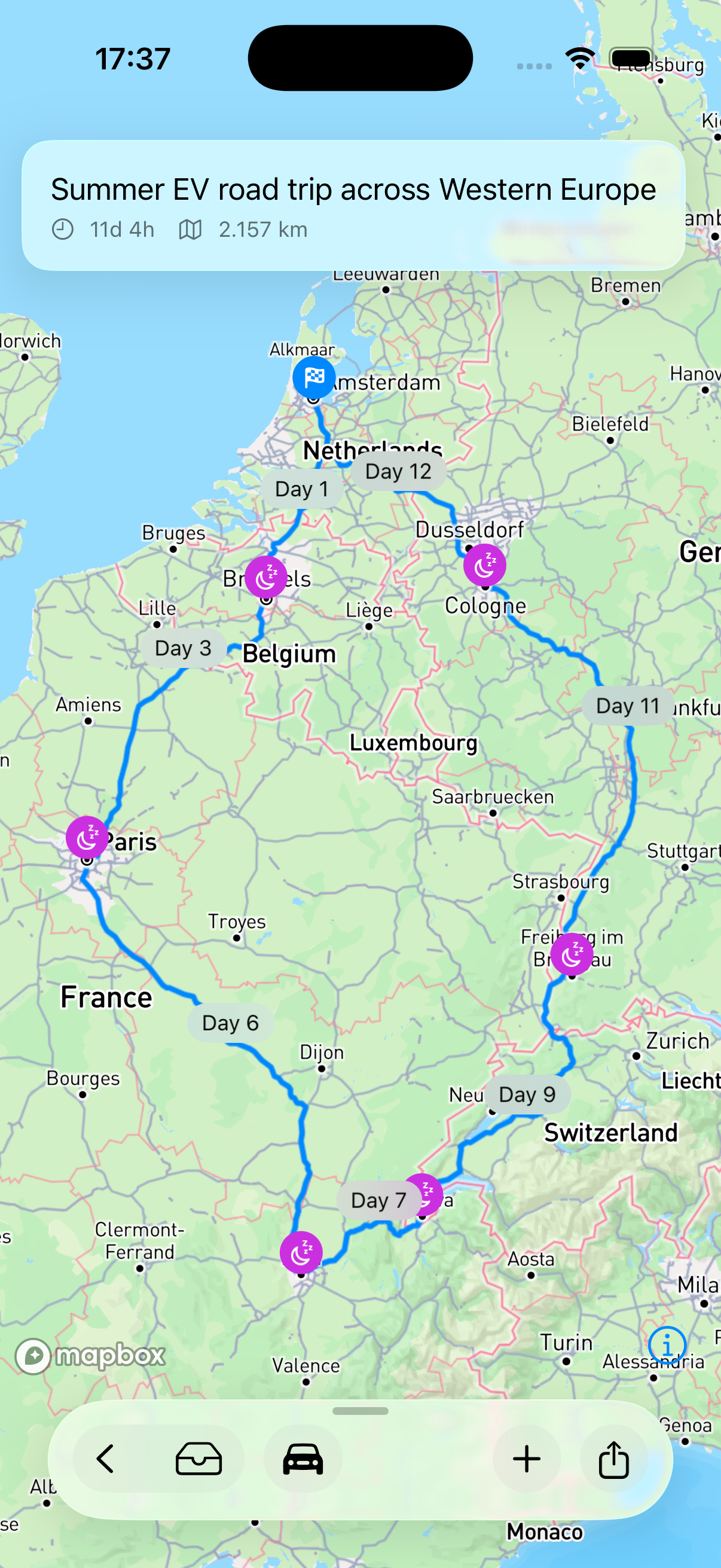
This post walks the planning process for a ~2,200 km Western-Europe loop — Amsterdam → Brussels → Paris → Lyon → Geneva → the Black Forest → Cologne → Amsterdam — through the country-by-country gotchas that catch first-time EV-Europe drivers. It's not a list of hotels. It's the planning framework, the kind you'd want from a friend who's done the route before.
The route in one paragraph
Two weeks, around 2,200 km of driving across seven legs, plus rest days in the cities you'd want to spend time in. The corridor runs Amsterdam → Brussels → Paris → Lyon → Geneva → Freiburg (Black Forest) → Cologne → back to Amsterdam. Five countries, no ferries, light on tolls, heavy on charging-network density. There are no detours into low-charging-density edges of Europe — no Croatian coast, no Highlands. This is the comfortable, defensible version of a Western-Europe EV trip, and it's the one to do first.
Gotcha #1 — Switzerland's vignette is annual only
Switzerland charges a CHF 40 motorway vignette for cars under 3.5 tonnes. It is good for 14 months (1 December 2025 to 31 January 2027 for the 2026 sticker), and — critically — there is no shorter option. Even if you're crossing Switzerland for one day on your way from Geneva to the Black Forest, you pay CHF 40 for the annual.
Buy it before you cross the border (physical sticker at any service station, or the digital "e-vignette" online), put the receipt with your passport, and don't think about it again. If you're caught on a Swiss motorway without one, the fine is steep and gets added on top of the vignette cost — not the way you want to start your week in the Alps.
France, Belgium and Germany don't have this kind of national sticker. France has distance-based motorway tolls (péage) you pay at the booth as you go; Belgium and Germany are mostly free for cars. The Netherlands has no motorway tolls at all.
Gotcha #2 — French autoroute charging is dense, but not uniform
France has roughly 165,000 public chargers. On the autoroute network specifically, four companies do most of the work:
- Ionity — the high-speed backbone. Around 850 charging points across about 100 stations in France, up to 350 kW. Pricing is 0.59 €/kWh with a subscription, 0.79 €/kWh ad-hoc.
- TotalEnergies — 2,800+ points across France, often inside existing petrol stations. Speeds vary widely — 22 kW AC at some sites, 175 kW DC at others. Roughly 0.42–0.65 €/kWh.
- Fastned — newer in France (over 50 stations as of late 2025), highly reliable, the yellow-canopied stations you see appearing on major routes.
- Tesla Supercharger — most French sites are now open to non-Tesla CCS cars. Pricing is competitive with Ionity for non-members.
The practical implication: don't trust a single network for the whole trip. Pre-install the apps for Ionity, Fastned and Tesla, and check the per-network coverage along your specific stretch of autoroute. The Paris → Lyon leg (~470 km) needs one mid-route fast charge regardless of which network you're using. Toll-and-charge subscriptions can be combined for cost-optimisation, but at trip-planning time the priority is reliability, not pricing.
Gotcha #3 — The Netherlands and Belgium are the easy bookends
Both legs of the trip are likely to be in the Netherlands or Belgium, and both countries are about as EV-friendly as Europe gets.
Fastned is headquartered in the Netherlands and has its densest national coverage there — 50-plus locations in Belgium too as of late 2025. Stations are well-spaced along major routes, generally have 6–14 stalls, and rarely queue. Urban charging in Amsterdam, Brussels, Antwerp and Ghent is also strong, so overnight street-charging at a hotel that supports it is realistic in either country.
The bookends are also where you'd want to schedule any planning rest days. They're the legs where, if something breaks, it's easiest to recover.
Gotcha #4 — Germany has 185,000 chargers, but slow down on the Autobahn
Germany has the largest public charging network in Europe, with around 185,000 chargers. Ionity, Fastned, EnBW, Aral pulse and Tesla all have strong national coverage. The infrastructure is not the issue.
The Autobahn is. On unrestricted stretches, EV range collapses at 180 km/h — air-resistance scales with the square of speed, and a car that does 380 km at 130 km/h might do 230 km at 180. Plan the German legs at 130 km/h, treat the no-limit zones as nice-to-have, and you'll spend less time at chargers and more time at destinations.
The same principle applies on long French autoroutes (legal limit 130 km/h, often 110 km/h in rain) — but it's the Germany leg that tempts drivers into the range hit.
Gotcha #5 — Summer heat costs you range, quietly
EV range loss in summer is real but smaller than winter range loss. Around 27 °C (80 °F), a typical EV loses about 2.8% range running its air-conditioning. At 32 °C (90 °F), it's closer to 5%. The worst-case figure — about 17% range loss — turns up only at 35 °C+ with the AC running continuously through stop-and-go traffic.
The practical planning rule: in July or August, add one extra mid-route charging stop on any day with a 400 km+ driving leg. The Paris → Lyon leg, the Geneva → Freiburg leg, and the Cologne → Amsterdam stretch are the ones to watch. Plan the charging stop as a meal (90 minutes, sit down, eat lunch) rather than a fast pit stop, and the trip gets less stressful, not slower.
Daily pace — 200 to 300 km is the sweet spot
Two weeks divided into 14 days with seven driving legs suggests an average of around 160 km of driving per day, but the shape is lumpier than that:
- Three or four longer driving days (350–470 km), each treated as the "we're moving" day.
- Three or four rest days (0–50 km), each in a city you want to spend time in (Brussels, Paris, Geneva).
- The remaining days at 150–250 km, with charging stops scheduled as lunch or coffee.
The pace mistake people make on their first Europe trip is treating every day as a driving day. The road trip is what happens between the driving days; if there are no in-between days, it's a car commute with extra languages.
What Fernweh does for a trip like this
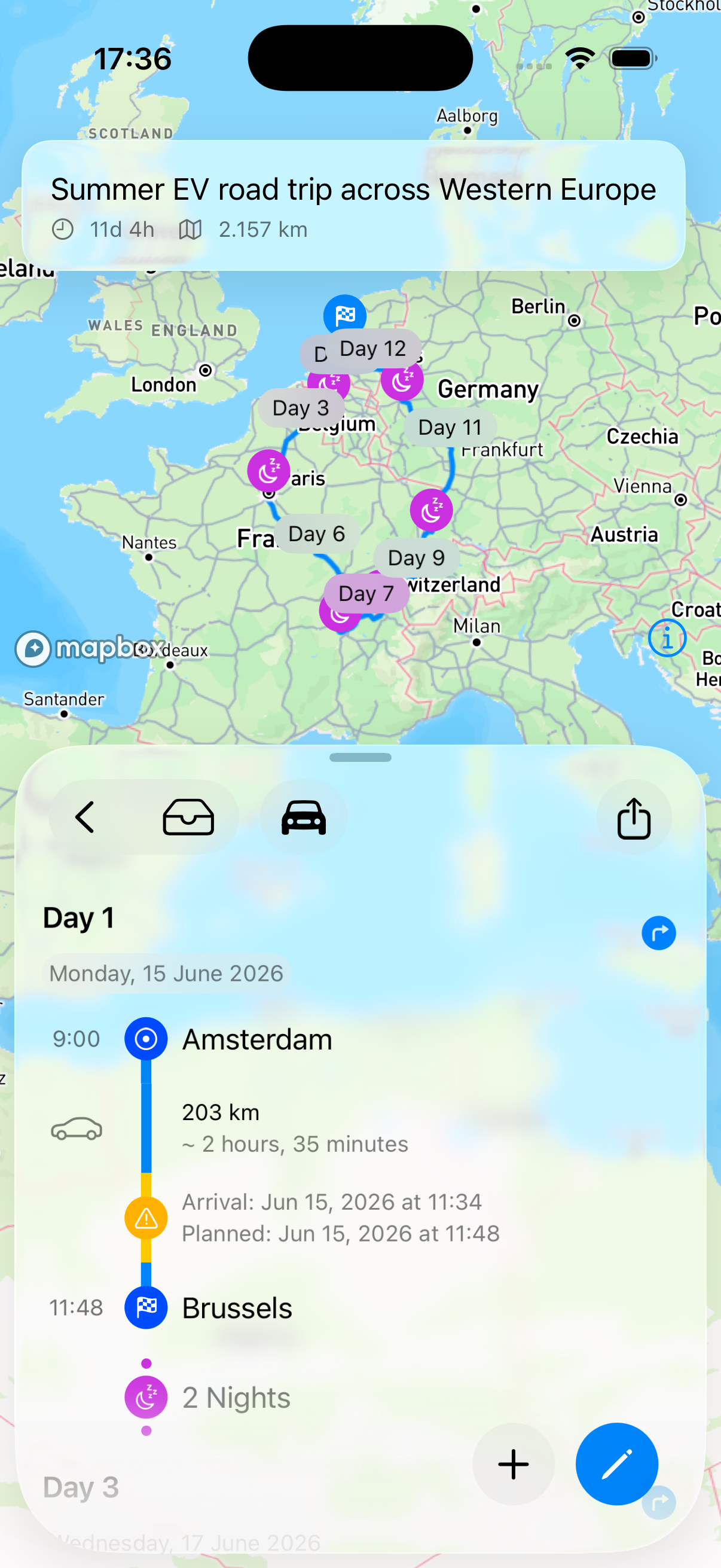
Fernweh plans the route as seven legs, computes per-leg distance and driving time, surfaces charging stops at the spacing your EV actually needs, and writes one calendar event per drive leg titled "Drive: Amsterdam → Brussels", "Drive: Brussels → Paris", and so on, straight into Apple Calendar. If you move a stop, the events update. If you add a rest day in Geneva, the dependent legs shift forward. The plan stays honest as you change it, which is the part most planners get wrong.
The country-specific gotchas in this post — vignette, network density, summer heat — are the kind of context Fernweh assumes you bring. Software can compute the leg distances. Knowing that Switzerland charges CHF 40 for one day on the motorway is on you.
Download the route
The full 14-day plan is available as a GPX file you can import into Fernweh or any other route-aware tool. Stops, intermediate waypoints, suggested charging legs — all in one file. Use it as a starting point and edit from there.
Fernweh is the road-trip planner for EV drivers. It writes one calendar event per drive leg, surfaces charging stops at the spacing your car actually needs, and treats the trip — not the app — as the first-class object. Available on the App Store: Road Trip Planner — Fernweh.